Thirty years translating work no one knew how to frame
I am American, born in Omaha, and I practice from Wall Street. I work in English, Portuguese, Spanish and French.
What I actually do is seek to understand your work better than any attorney who has looked at your case. That is where the argument comes from.

The range
In addition to extraordinary Product Managers, Finance Professionals, Cyber and Other Technically related fields, this office has secured green cards for World Class Athletes, graphic design artists, woodcarvers, Award winning Actors and musicians.
That is a real list of clients I have represented over more than thirty years. None of them look alike.
What they had in common was the problem: no one knew how to convincingly translate and project what they do into the language the American government understands within the parameters of the statute that favor those with demonstrated talents that lend a decisive advantage to the United States’ economy and/or society.
Most attorneys specialize in one field. They review a case, evaluate it as if it were similar to cases in the hyper-specialty of the attorney and (erroneously) conclude there is not enough material. The material almost always exists. It sits where that person does not know to look.
My clients come through referrals from other clients, inside the companies where they work, and through referrals from classmates at such institutions as Carnegie Mellon, Hult, Princeton, Wharton and UPitt.

How I work
- 01
I meet on your schedule. Weekends and evenings included. My clients work eighty, sometimes one hundred and ten hours a week. Scheduling a meeting at ten on a Tuesday morning asks them to choose between the case and the job.
- 02
I listen before I write. You know your work better than I ever will. What I know is what the government looks for, and how to prove it. The interview is intentionally thorough.
- 03
I condense. I condense a four-page resume to eighty and back down to twenty. The government does not want volume, it looks for weight. Too much material buries the argument instead of supporting it.
- 04
Every consultation is with me. All legal services, including every conversation, are provided directly by the attorney. You are never handed off to a paralegal.
- 05
I take few cases. A volume firm handles fifty cases of your type a year. I select from three to no more than five new cases per month. Thus, each case receives the personalized and intensive attention and care it deserves and is required for approval.
Wall Street, and a phone number I do not change
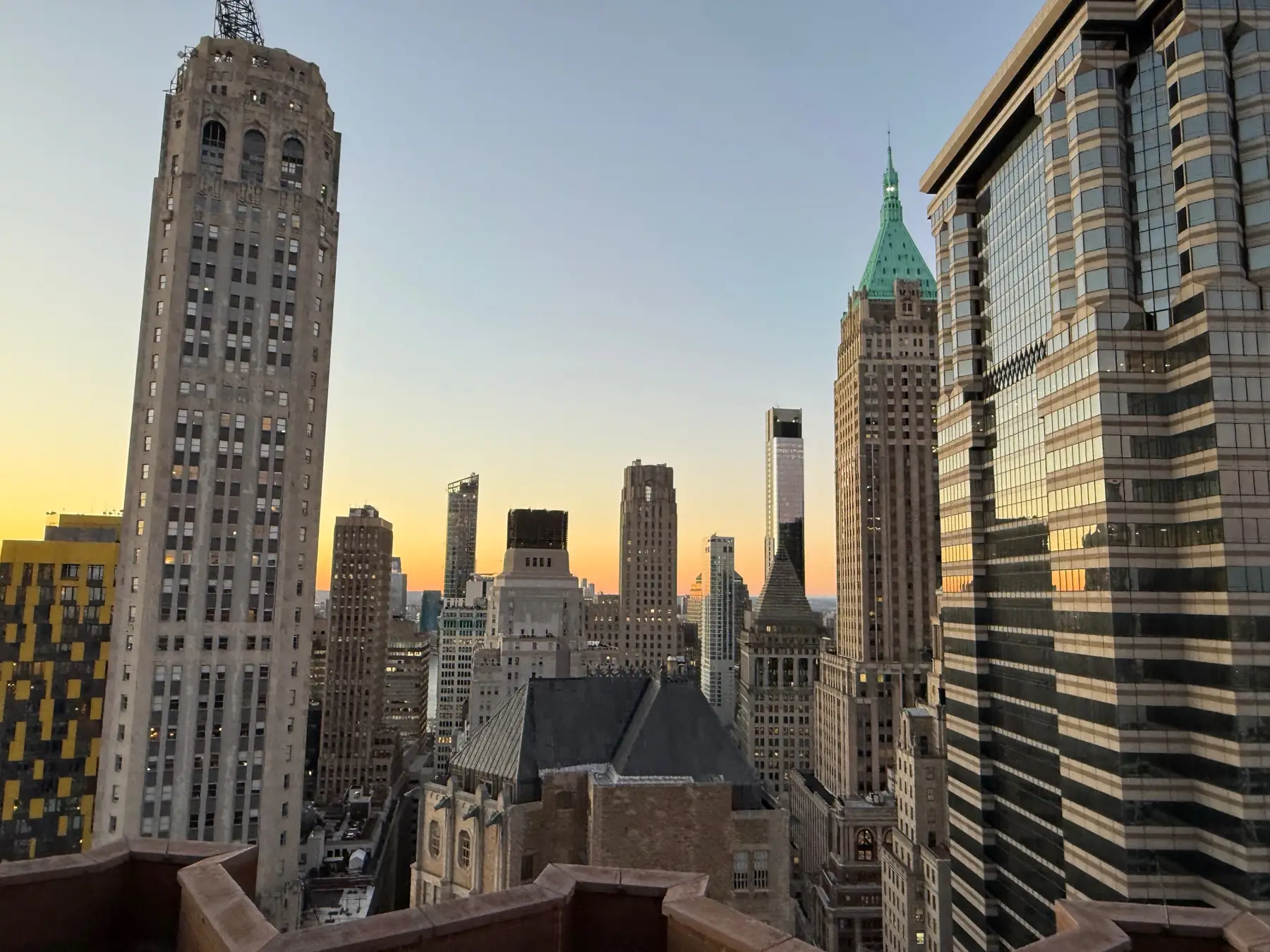
The office is at 75 Wall Street, in New York.
The number carries a 212 area code. I could have changed it many times, and I never did. People who heard that number ten or twenty years ago still call it. It is worth more than anything I could print on a card.
In one of the photographs on this site my jacket is open. The lining carries Indian beading and the label of the man who designed and crafted it.
Nauman Piyarji tailored wardrobes for stock brokers and other captains of industry, as well as the cast of Ryan Serhant’s “Million Dollar Listing New York,” filmed on Wall Street. While Nauman did not survive the pandemic, his high fashion garment legacy remains.
I have spent thirty years proving that craftsmanship at the highest level deserves the same recognition as technical work. I wear his suits every day.

Why me? Why Immigration?
Raised in a suburb with dirt roads, a “crick” separating his elementary school from the “standard 160-acre” Fricke farm, he “road bikes” until dark and “chased lightning bugs.” The cattle’s baying eight blocks away before heading to auction competed with the cicadas’ insistence on telling and re-telling their own version of this reality. It was ALL, “still Omaha.” After all.
LaVista, with an optional capital “V.” Next to Ralston, as in Purina. The ubiquitous red and white checkerboard emblematic of farms and a brand of innocence that is never to be confused with ignorance.
It is said that the best sailors come from the farm. In the early 2000’s three consecutive chief consuls in Rio de Janeiro hailed from the Heartland.
Not “wanderlust” per se. Rather, a profound recognition that there is always more.
And, while always “happy,” never “satisfied.”
Driven to study in this nation’s higher education “Mecca,” he headed East, to Boston. There, everyone wants – and expects – more.
Upon completing all but his last semester and at the dawn of the Latin American spring, he headed to Montevideo with its own fledgling democracy. He traveled extensively throughout Argentina, Chile and countless climes in Brazil where few locals dared tread.
Asking the driver from the airport in Buenos Aires if the locals sensed the pall over the neighborhood next the airport, he was met with a tremulous response: “Why? What do you know?” It was Eseiza. One did not speak of Eseiza. Indeed, there was no need as there were no words.
Experiencing the Joie de Vivre or Rio de Janeiro and the profound brooding of all that is Brasilia, he returned to Buenos Aires staying in a 1,5M x 2,5M room overlooking the powerlines one flight up on Calle Florida in “el Centro.”
Why, Uruguay? Potable water, great steak and they didn’t resent Americans quite as much as almost everyone else did at that point in history.
He discovered “America’s future”: multiculturalism.
His undergraduate program was heavy in math and science. Gifted with a strong background in Latin, French, Spanish and Portuguese came “naturally.” Still, in other countries, he stood out as a “Yankee.” He always took that as a compliment with all of its positives and strove to use those prejudices to his own advantage.
When others said it could not be done. He was already onto the next project. And the next. The more impossible, the more attractive the challenge.
And now, from Wall Street, he “brings the best of what the rest of the world has to offer home.” Just like the lightning bugs in the field behind his boyhood house.